This blog series co-published by West Coast Environmental Law and Ng Ariss Fong, Lawyers features interviews with leaders and experts discussing the UN Declaration on the Rights of Indigenous Peoples (UNDRIP) and its relationship to the economy in BC and Canada.
Responsible mining respects the title and rights of First Nations
In its recent decision in Gitxaała v. British Columbia (Chief Gold Commissioner), the BC Court of Appeal found that the provincial government has a legal duty to cooperate with First Nations to align its laws with UNDRIP. It also held that BC’s outdated mineral claim regime is inconsistent with UNDRIP.
Little progress has been made since BC committed to reform its Mineral Tenure Act in 2022. While the government is dragging its heels on this important priority, mining approvals continue apace, and BC has announced plans to amend the Declaration on the Rights of Indigenous Peoples Act (Declaration Act or DRIPA).
Unfortunately, by doing so, rather than moving forward with implementing the clear direction from the BC Court of Appeal, BC is prolonging the uncertainty that has raised concern in industries like mining.
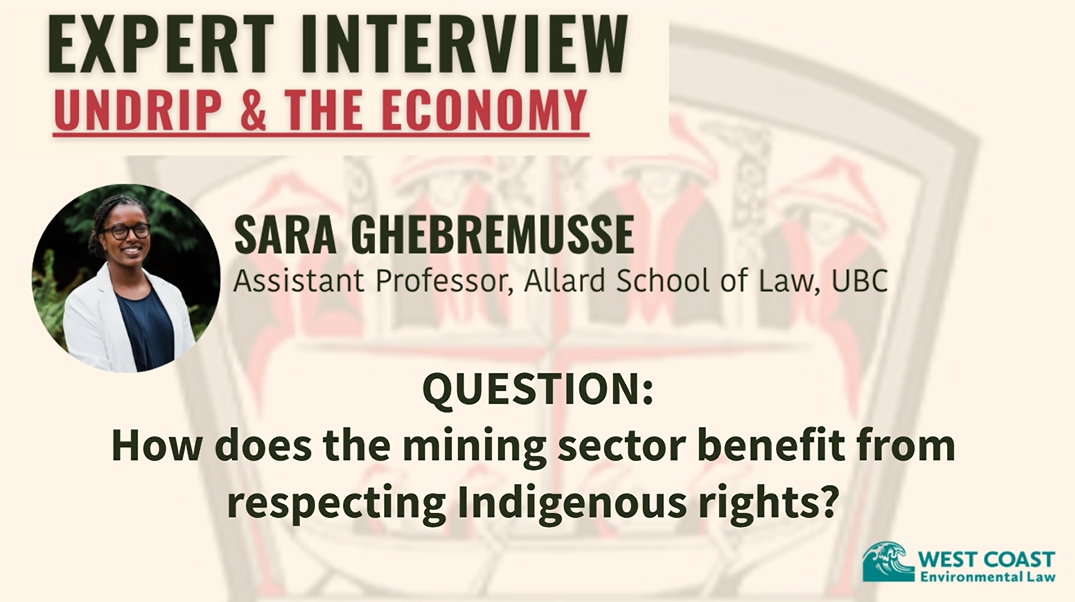
As part of the University of British Columbia’s Future Minerals Initiative, law professor Sara Ghebremusse works to shed light on the impact that mining has on affected communities and the environment, and potential solutions to advance a responsible mining future. West Coast’s Executive Director & Senior Counsel Jessica Clogg sat down with Sara to talk about her perspective on what implementing the Declaration Act means for the mining sector in BC.
Key takeaways:
- Mining is going to happen, and doing it responsibly means adhering to the rights of First Nations whose territories are affected.
- The Declaration Act offers a pathway to ensure mining is done responsibly – which reduces the risk of legal, logistical and other challenges.
- Indigenous consent is compatible with a thriving critical minerals strategy in BC.
Watch the video (transcript below):
Q: How would you say that the mining sector benefits from the Declaration on the Rights of Indigenous Peoples Act or generally from respecting and upholding Indigenous rights?
A: As we know, mining is going to take place, and mining in British Columbia and in so many parts of Canada and around the world is taking place on the territories of Indigenous peoples. And so for mining to be done responsibly, it should be done in a manner that respects the rights and interests of the traditional landowners. And here in BC, where so much of the province is not governed by treaty, the Declaration on the Rights of Indigenous Peoples Act offers a way to greater protect the rights of Indigenous peoples on their traditional territories in a way that has not been done so far by treaty in some cases, or in ways in which section 35 of the Constitution Act might fall short.
And so what that offers, I think, to the mining industry is an awareness and ability to ensure that any mining that takes place on Indigenous territories is done in a manner that adheres to the rights and interests of the traditional landholders. And if that means that the consultation process that the First Nations are involved in goes beyond what's currently required under section 35 of the Constitution Act, then I think that is meaningful to ensuring that mining is done responsibly in a manner that protects First Nations rights.
Q: What is the benefit to the mining sector of acting in that responsible way?
A: There are, of course, legal benefits to doing that. They're ensuring that they are conducting a mining project – if they have the willingness of the First Nation to proceed – they're actually conducting a mining project that will likely face little to no legal challenges, which is of course beneficial to the sector. Because we know any legal challenges can take a long time for them to proceed to the courts. They're very costly.
And also having the buy in from the First Nation, if they decide that they actually agree to the mining project taking place, does ensure that that project does not face a type of, whether it be legal, logistical, or other type of challenges.
Also, I think the input from the First Nation would ensure that a mining project could potentially proceed in an environmentally responsible way as well. And that could benefit the industry as it will, once the project is concluded, perhaps allow for remediation that is done in accordance with, you know, that First Nation's relationship with the environment, and also can ensure that there are sort of no hurdles or obstacles at that stage of the project as well to the mining project being concluded.
Q: In your view, is Indigenous consent compatible with a thriving critical mineral strategy in BC?
Absolutely. Without Indigenous consent, mining is not a responsible industry in this province.
Yes, we need mining. We need the metals that a critical mineral strategy is trying to get out of the ground. But that can't be done at the expense of First Nations, at the expense of the environment that Indigenous peoples in British Columbia have shepherded and ensured has thrived for, you know, for millennia. If we want to ensure that the critical minerals that we’re taking out of the ground are actually used for the economic benefit of the province to ensure a transition to a greener economy, it cannot be done at the expense of First Nations' rights, and of the environment and lands that First Nations have protected for so long.
And so, Indigenous consent is the way that that can be done. And the DRIPA Act, in my view, is meant to actually ensure that Indigenous consent becomes part of the law here in British Columbia. And what that will do, as I said, will ensure that the critical minerals, a critical mineral strategy is a responsible mining strategy, and is one that is done in adherence with the rights of First Nations on whose land all of this mining is taking place.
UNDRIP and the Economy Series:
- How does respect for Indigenous rights relate to the economy? Feat. Tahltan Elder Allen Edzerza
- Will the economic sky fall? Feat. Gitxaała Chief Councillor Linda Innes
- What do recent court decisions mean for the economy? Feat. Lawyer John Gailus
- What does upholding Indigenous rights mean for the forestry sector? Feat. Professional Forester Garry Merkel
- What does upholding Indigenous rights mean for mining in BC? Feat. Law Professor Sara Ghebremusse