This blog series co-published by West Coast Environmental Law and Ng Ariss Fong, Lawyers features interviews with leaders and experts discussing the UN Declaration on the Rights of Indigenous Peoples (UNDRIP) and its relationship to the economy in BC and Canada.
Respecting Indigenous rights is crucial for forest stewardship
Under BC’s Declaration on the Rights of Indigenous Peoples Act (Declaration Act), the provincial government has a legal duty to bring all provincial laws into alignment with UNDRIP. The BC Court of Appeal has now affirmed this legal obligation – so what does it mean for different sectors of the economy?
Implementing UNDRIP in a meaningful way will require changing the way we do things, including how governments approach decision-making about land, air, water and forests. Making these changes may be challenging, but can also bring about important benefits like strong government-to-government relationships, long-term sustainability and predictability for industry.
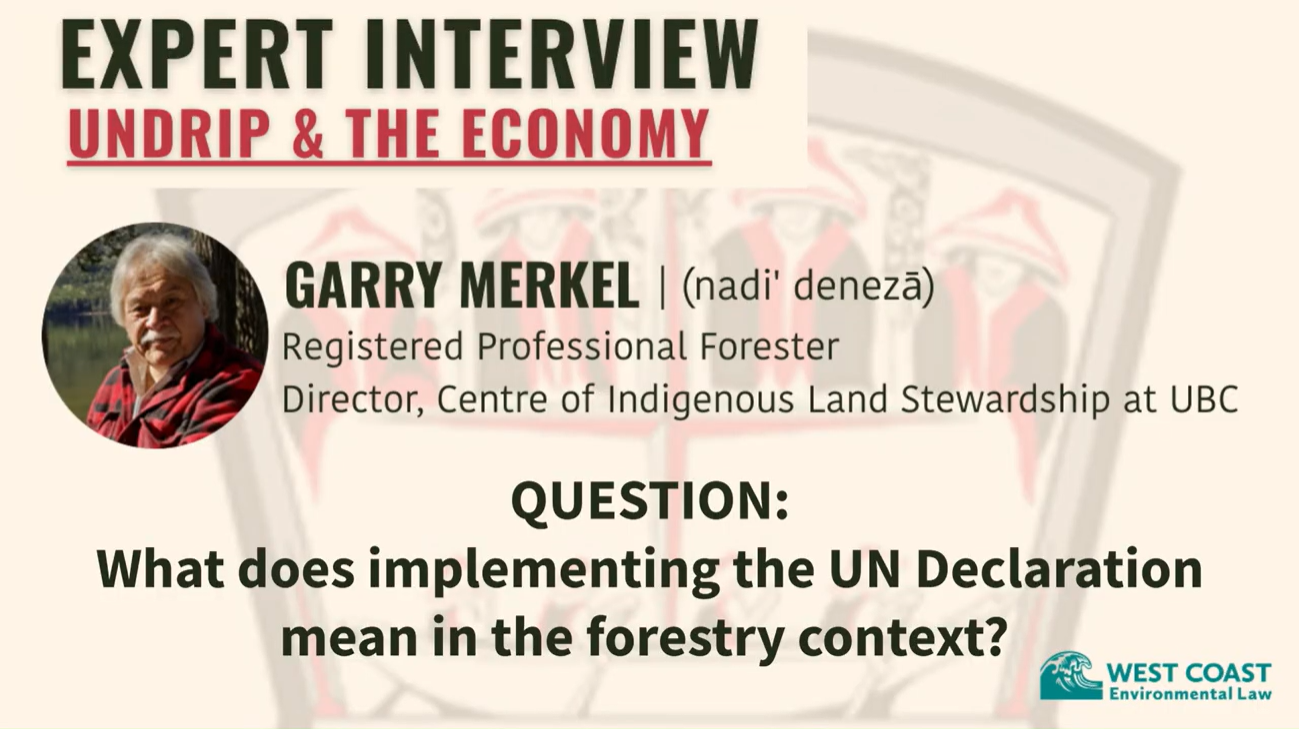
West Coast’s Executive Director & Senior Counsel Jessica Clogg spoke with Garry Merkel (nadi’ denezā), a Tahltan professional forester and Director of the Centre of Indigenous Land Stewardship at UBC’s Faculty of Forestry, about what it means to respect Indigenous rights in the context of the forest sector.
Key takeaways:
- Implementing UNDRIP requires a societal shift – it won’t always be easy, but it’s necessary for our communities to prosper together.
- Including First Nations in all stages of forest management can give the sector more long-term stability in terms of access to raw materials, by incorporating values and approaches that work within the bounds of nature.
- Indigenous rights have been recognized as part of the core fabric of Canada; upholding those rights is not just the right thing to do, it’s the only thing to do.
Watch the video:
Q: From your perspective, what does aligning laws and decision-making with the UN Declaration mean in the forestry context?
A: It means that Indigenous people would be involved in all aspects of looking after forests, right through from particularly stewardship through to the economy side of it.
Q: What might the economic benefits of that [upholding the UN Declaration] be?
A: We’ve been living under a bit of an illusion for a long time that we can build a growth resource economy, and I think many are now starting to realize that that isn’t true – that you cannot build that because nature has boundaries. What you need to strive for is long-term stability, I’ll call it predictability, reliability, on the resource side, as much as you can get it, subject to nature, by living within the bounds of nature and doing that in a way that’s grounded in the population, so that as stable as it can be over time.
The good things about First Nations is that many First Nations inherently are trying to integrate this land ethic into their land management – an ethic that says try to live within nature, try to live with it as much as you can, try to build your planning and your use and your development within the bounds of nature.
First Nations are really, really helping us in this regard, in many, many areas right now in forest and all kinds of resource management, but particularly forest management in British Columbia because it touches so many people.
What that type of approach does is it gives us the stability that we need on the raw materials side, and on forests. And once you have that stable supply you have the foundation to build strong stable economies – especially where you have communities who are very interested in building economies that are not just about commodities but more about local and increased value (which First Nations are very interested in). Building a stable economy is much easier to do when you’ve got a stable, secure supply that you can count on.
Q: What has been the cost – or what could be the cost – if we fail to uphold Indigenous human rights?
A: Well, Indigenous people are tribal people to start with. So when you decide to take on something like undermining Indigenous rights, it becomes an attack on the collective and people band together – in a society with this kind of a culture, the wellbeing of the whole is generally more priority than the individual wealth or the “getting-ahead-ness” of the individuals. You will see a quick and coordinated movement of the collective of First Nations orchestrating disruption – in the form of legal, financial, and everything else – and undermine that system and hurt it bad until it finally listens.
Fulfilling Canada’s obligations to Indigenous rights or Aboriginal rights in Canada is not a policy decision. It’s a constitutional imperative. Not only do we have to fulfill our consultation and accommodation obligations – and those are fairly high tests with a high bar, but you also have to do that in collaboration with Indigenous people. The law is pretty clear on all of this.
So, it’s not very hard when the Crown or others start to push and start stepping outside of those lines, to just get an injunction or cause enough pain that it’s going to cause major delays. And major delays cost lots of money, they cause uncertainty, they cause a lack of investor confidence.
Q: What learnings would you like to share with those who are feeling worried right now about the impact of Indigenous rights on the economy?
A: Firstly, we must understand that these rights have been recognized as part of the core fabric of Canada. They existed prior to the Constitution, they’re part of our common law, and they have been recognized and affirmed in our Canadian Constitution. They have been recognized by the highest law in the country – there’s no appealing these anymore. You can’t write law to override them – you can’t do anything to override them. They are part of Canada. Period.
Now, you can be pissed off and not like that. Just like you can be pissed off that women got the right to vote, that we have freedom of religion or other similar things. But the problem is, if you continue to try to undermine it or make it go away then you become part of the problem and not the solution. These things are not going away.
This is not a question of whether this is the right thing to do – because this is the only thing to do. There is no other option here. You can’t throw the Constitution out. You can’t undermine it. There are too many economic and social and every other barrier beyond just those legal barriers, that we can’t not do this. It’s just too integrated into our society. The job now is to figure out how we’re going to do it. And so, let’s focus on that.
The second realization is that Indigenous peoples also want economic stability, but they are not willing to trade that stability for their rights or to undermine the health of their homelands. The land is meant to be used – the question is not if but how we use it that matters. Many of our current issues are caused by development interests trying to push their agenda at the expense of Indigenous rights or the health of their lands. That pushes Indigenous people into a position where they are forced to fight back to save the things precious to them. This is further complicated by a long history of this disrespectful pattern of behavior making it very hard for Indigenous groups to trust proposals even if they are more respectful – fool me once, shame on you – fool me twice, shame on me.
Note: The written Q&A above has been edited by the interviewee for clarity and to incorporate additional insights.
UNDRIP and the Economy Series:
- How does respect for Indigenous rights relate to the economy? Feat. Tahltan Elder Allen Edzerza
- Will the economic sky fall? Feat. Gitxaała Chief Councillor Linda Innes
- What do recent court decisions mean for the economy? Feat. Lawyer John Gailus
- What does upholding Indigenous rights mean for the forestry sector? Feat. Professional Forester Garry Merkel