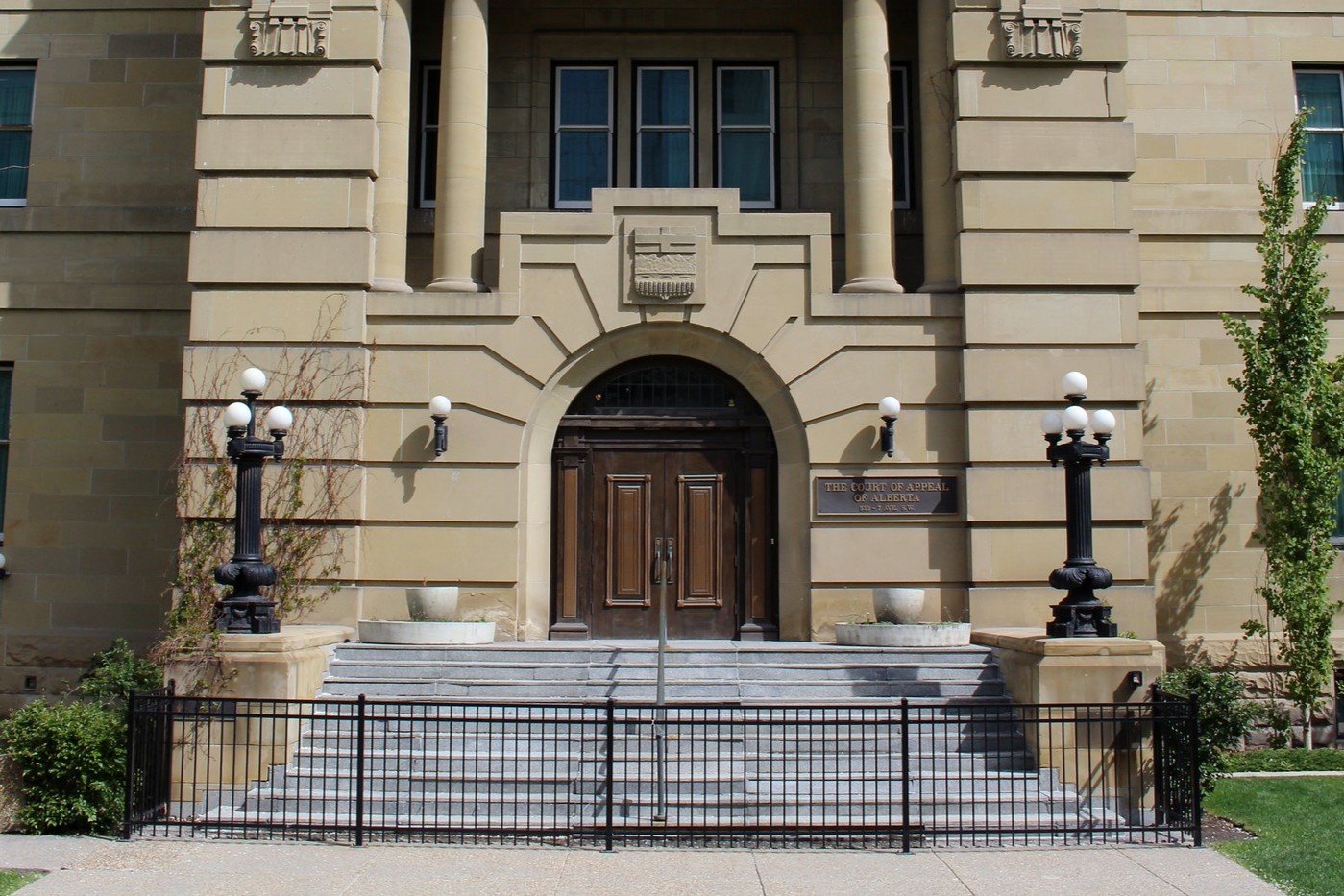
From February 24-26, I was at the Alberta Court of Appeal on behalf of Nature Canada and West Coast Environmental Law defending the constitutionality of the federal Impact Assessment Act (IAA). This wasn’t my first rodeo – Alberta challenged the constitutionality of the IAA soon after it was enacted and we intervened in that case all the way up to the Supreme Court of Canada.
In 2023, a majority of the Supreme Court ruled that the main scheme of the IAA overstepped Canada’s constitutional bounds. The federal government amended the Act to bring it in line with what the Court said, and Alberta promptly launched a second constitutional challenge to the amended Act.
What is an intervention?
Because constitutional cases like this one can have far-reaching implications, parties may be granted leave to intervene in order to help illuminate the issues. To qualify, parties need to demonstrate they will either be directly affected by the outcome or have a special expertise or unique perspective to bring to it.
Nature Canada and West Coast were granted leave to intervene jointly due to our extensive expertise in impact assessments, and because both use it to pursue our mandates. Two provinces intervened – Saskatchewan and Ontario, in support of Alberta’s position that the Act is unconstitutional – along with seven other non-governmental organizations and one First Nation. Six of the non-governmental interveners (various think tanks, business associations and the Indian Resource Council) took Alberta’s side, and the other two – our friends at Ecojustice and the Cold Lake First Nation – helped us defend the Act.
What we argued
As interveners, our job was not to simply defend Canada’s position, but to help the Alberta Court of Appeal understand the case’s nuances and complexities, as well as the implications of whatever decision they come to. We focused our submissions on why impact assessment is an important tool for informing decisions about the environmental effects of resource and infrastructure development, and why Canada’s jurisdiction to conduct it needs to be interpreted broadly.
The purpose of impact assessment
I began by situating the Court in the ecological reality that environmental components exist in systems, not silos. The “environment” is a multifaceted concept that touches on different federal and provincial powers. Environmental effects interact with each other regardless of whose jurisdiction they fall under. A bear doesn’t know that it is provincially regulated any more than a fish knows it is part of federally-regulated fisheries. And yet, harming bear populations can affect fish and fish habitat, and vice versa.
Over the course of the hearing, some of the justices on the five-judge panel questioned the purpose of the IAA when Canada has a number of other laws aimed at protecting the environment. I argued that those other laws are narrowly focused only on whatever environmental resource they are meant to protect. The Fisheries Act just looks at impacts on fish, the Migratory Birds Convention Act just looks at migratory birds, and so on.
One of the fundamental purposes of impact assessment is to take a more holistic look at all those effects so decision-makers have a more accurate understanding of the way that effects interact and can better manage them.
Parliament’s authority over adverse effects
Another line of questioning the justices asked throughout the hearing was about whether provisions in the IAA prohibiting “non-negligible” adverse federal effects was too low of a threshold, and whether Canada should only be permitted to prohibit “significant” effects. Their questions appeared to stem from a concern that the federal government could use insignificant effects on things like fisheries as a premise to stop a project from proceeding.
We pointed out that cumulative effects (effects that build up over time) are the most serious and important effects to manage, as well as the most challenging. Significant, even catastrophic cumulative effects can occur as a result of individually insignificant ones.
If Parliament’s authority was limited to only prohibiting and regulating significant adverse effects, the environmental components it has jurisdictional responsibility for, like fisheries, migratory birds and navigable waters, would be at risk of dying a death by a thousand cuts. The government’s ability to manage and protect those values depends on its ability to enact laws to prohibit and manage individually insignificant effects.
We argued that the Alberta Court of Appeal should follow the Supreme Court of Canada’s direction in the first reference case and recognize that impact assessment necessarily “launches from a point of informational uncertainty” (para 143). Quoting Professors MacLean, Doelle and Tollefson, the Supreme Court emphasized that “the full implications of proposed activities cannot be properly understood, if at all, until an assessment is well underway if not completed” (para 144). In light of that fact, “Requiring definitive proof that a project will have effects on areas of federal jurisdiction prior to an impact assessment would put the cart before the horse and undermine the precautionary principle” (para 146).
Accordingly, the prohibition against adverse federal effects must be based on the potential for non-negligible harms, rather than a higher threshold of harm. It may not be clear at the designation stage whether the seemingly individually insignificant effects may contribute to significant cumulative ones, which is exactly why it’s so important to investigate these potential effects through impact assessment.
To find that Parliament can only prohibit significant adverse federal effects would almost certainly lead to assessments failing to identify the full spectrum of effects that can interact and accumulate into significant ones, and would be a slippery slope down to the evisceration of federal jurisdiction.
What types of effects are federal?
Much of Alberta’s argument focused on the broad scope of effects the IAA requires assessments to consider. But as the Supreme Court of Canada found in the first IAA reference case, there is no limit on the scope of factors that federal assessments can consider. Constitutional limits only apply when decision-makers are making the final decision about whether to allow the adverse federal effects.
As we argued, a broad scope of factors helps make sure that the assessment identifies all the ways even individually insignificant effects may interact and accumulate in order to ensure that the final decision is based on an accurate understanding of the full range of adverse federal effects. For example, dust from trucks may on their own appear insignificant, but combined with idling trucks and other sources of air pollution, they might result in significant health impacts on a nearby Indigenous community.
For the same reason, the Minister’s ability to impose conditions on approvals cannot be limited to only measures to avoid or mitigate significant harms. Because there are often multiple sources of significant effects, the Minister needs to be able to impose conditions related to each of those in order to ensure that they don’t cause excessive harm.
Relatedly, because decisions must consider impacts on Indigenous peoples’ health and well-being, it must be the case that the final decisions identify the significance of adverse effects along a spectrum, rather than a binary significant/insignificant determination. Having a spectrum of low, medium and highly significant effects recognizes that not all effects should be treated equally.
Significance determinations are made by looking at things like duration, timing, frequency, reversibility and magnitude of harm. Dust caused by truck traffic and machinery along dirt roads during daylight hours may not significantly affect migratory birds, but if it leads to higher asthma rates among First Nations children, it is significant. A binary significant/insignificant test would put decision-makers in the untenable situation of applying the same standard of harm on Indigenous children’s health as it does on bird populations.
A sustainability lens
We also explained the importance of having a sustainability lens in assessments. The IAA requires decision-makers to determine whether a project’s significant adverse federal effects are justified in the public interest in light of the assessment report and three factors: impacts on Indigenous peoples, the extent to which the project’s effects help Canada meet its climate and nature goals, and the extent to which they contribute to sustainability.
Those justification considerations were a real sticking point for multiple justices on the panel, particularly the sustainability factor. Originally, the IAA’s decision provisions allowed decision-makers to consider all of a project’s impacts and benefits when deciding whether the adverse federal ones were in the public interest. In the first reference case, a majority of the Supreme Court held that federal decision-makers cannot let adverse effects that are provincial in nature “stack up” on the “adverse” side of the ledger in the cost-benefit analysis. Instead, they can only consider the federal effects plus any provincial benefits (for a critique of that decision, see this paper I recently published with co-authors Martin Olszynski and David V. Wright).
When Canada amended the Act, they removed the ability to consider adverse provincial effects in the justification determination. Alberta was arguing – and some of the justices appeared to agree – that the amendments didn’t go far enough, and the sustainability lens allows that “stacking up” to still occur against the project’s favour.
I argued that the sustainability lens is simply a framework for determining how positive a project’s stated benefits really are. Impact Assessment Agency of Canada guidance outlines four principles to guide the sustainability analysis. They are:
- Consider the interconnectedness and interdependence of human-ecological systems;
- Consider the well-being of present and future generations;
- Consider positive effects and reduce adverse effects of a designated project; and
- Apply the precautionary principle and consider uncertainty and risk of irreversible harm.
I gave the Court a hypothetical example based on the environmental assessment of the Voisey’s Bay nickel mine, which applied a sustainability lens. As we wrote about in this report, the project would have significant adverse effects on fisheries and other federal values that could last decades, if not into perpetuity. Those harms would only be justified by the jobs, provincial revenues and other economic benefits. But when Voisey’s Bay was first proposed, the proponent wanted to maximize the mine’s production capacity to extract the ore as quickly as possible, meaning that it would only operate for a short period of time.
Local communities welcomed the idea of jobs but were worried about a boom-and-bust cycle. When those concerns surfaced in the assessment, the proponent agreed to lower the production capacity and extend the lifespan of the mine to at least 30 years. That was in 1997. Voisey’s Bay is still operating to this day.
The sustainability lens that the assessment review panel applied in the Voisey’s Bay assessment was not required under the old legislation. The panel simply decided to apply one of their own. For mines assessed under the IAA today, the sustainability lens helps ensure a similar approach is used to verify things like whether the jobs are quality, long-lasting ones that impacted communities can access. It also adds transparency and credibility to assessment decisions.
Under the previous legislation, assessment decisions were about whether the significant adverse effects were “justified in the circumstances.” The circumstances were not defined, and decision-makers didn’t have to give reasons for their decision. Under the IAA, they do. The justification factors and the need for detailed reasons make the IAA a tool for lending public legitimacy to federal decisions about major projects that significantly affect federal environmental values.
A time of crisis
Finally, in court we argued that in this time of the twin biodiversity and climate crises, along with other environmental disasters, Canada’s model of federalism needs to be an “all hands on deck” approach to environmental protection. Over the years, the Supreme Court of Canada has identified principles of what it calls “cooperative federalism” for dealing with cases like this when one order of government is challenging another’s jurisdiction. Under a cooperative federalism approach, courts should accommodate regulatory overlap rather than try to force governments into regulatory silos that could lead to jurisdictional vacuums. Given the intertwined nature of the environment, those principles should apply in a manner that best preserves both provincial and federal regulatory authority.
Justice Grekol, the lone dissenting voice of the Alberta Court of Appeal in the first reference case, put it beautifully. It’s lengthy, but worth repeating in full here:
[447] Oversight of environmental impacts cannot be the monopoly of one level of government, as environmental impacts are ubiquitous, touching upon a multiplicity of diverse interests, from an individual project’s sometimes minor effects upon limited numbers of people at a community level to cumulative effects that attain the magnitude of existential threat to all peoples at a global level. Canadians might be surprised, or even alarmed, by the notion that natural resources projects such as in situ oil sands extraction facilities are immunized from federal environmental regulation.
[448] Within this country, Canada geese will fly over tailings ponds north of Fort McMurray without heed of jurisdiction. Fisheries will be disrupted by damming waterways or constructing pipelines that transcends provincial boundaries. Effluent from a potash mine in Saskatchewan may affect the health of Québécois or Indigenous peoples living downstream along a river system that has no regard for provincial borders. A proposed coal strip mining operation on the borders of Banff or Jasper National Park may affect the roaming elk herds whose breeding grounds are deep within the Parks or may contaminate the headwaters of rivers meant to provide clean drinking water to Alberta ranchers and Indigenous communities. An oil spill in Clayoquot Sound may contaminate beaches in the wilderness beloved by Canadians, jeopardize the livelihood of local Indigenous peoples, disrupt the tourism economy of Tofino residents, and pollute coastlines abroad. Environmental concerns engage the interests of a complex matrix of jurisdictions and all Canadians, affecting the air we breathe, the water we drink, the food we eat, and are best addressed as the shared responsibility of all levels of government, with Indigenous peoples the first among equals, given their historical stewardship of and continued reliance upon the land.
We concluded by emphasizing the many amendments Canada made to the IAA in an effort to bring it into conformity with what the Supreme Court said. While it may be that there is still wiggle room under the Act for federal officials to stray outside federal jurisdictional bounds, Canada made it clear in its arguments that it intends to stay within its constitutional lane.
A continued role for Canada in impact assessment
As Justice Jamal, writing for the Supreme Court minority opinion in the first reference case, held: “jurisprudence instructs courts to approach both federal and provincial legislation from a posture of respect by applying a presumption that legislators enact laws with a good-faith intent to stay within the limits of their jurisdiction, and by interpreting legislation to comply with the Constitution when possible” (para 219).
The IAA also requires decisions to be accompanied by detailed reasons explaining the justification analysis, providing a guardrail and oversight mechanism. There is simply no reason or need to assume that federal officials might implement the Act unconstitutionally at some point in the future. Even if the Minister did allow non-federal effects to “stack up” against the project, or otherwise act unconstitutionally, proponents would have recourse to courts that would be able to rectify the situation.
We were proud to be able to make those submissions to the Alberta Court of Appeal, and are waiting to see what the court decides.
Top photo: C Hanchey (Flickr creative commons)